

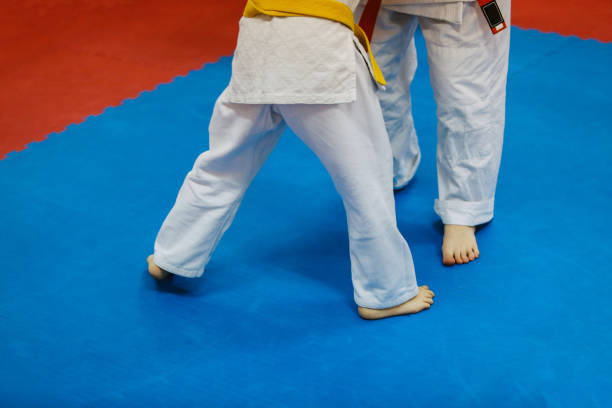
A hall used for martial arts on Tuesday, dance on Wednesday and community events at the weekend cannot be treated like a permanent gym. Every training session begins with a change of purpose. The floor must be assembled, checked, used and cleared without putting pressure on the next booking. A flexible plan starts with the timetable and the people responsible for each changeover, rather than the number of square metres available.
First, identify what the club really needs to cover. Mark the active practice zone, a buffer around it and a separate area for bags or spectators. The space between participants and hard walls, furniture or doorways matters. Do not count corridors or emergency access as usable matting area. A scaled sketch helps volunteers agree on a consistent layout, especially when different groups assemble the space each week.
Interlocking jigsaw mats may suit a shared venue because sections can be carried and arranged without a permanent installation. That flexibility does not mean every interlocking product is suitable for every discipline. Surface grip, thickness, impact performance and the manufacturer’s intended use still matter. Training with repeated throws can demand a different system from floor-based drills. Clubs should choose a product for their actual activities, not simply because it packs away neatly.
A reliable assembly routine is essential. Staff or trained volunteers can start at a marked corner and build outward in an agreed direction. Sections should fit firmly, lie flat and form a stable edge. If perimeter pieces are supplied, use them as directed. After installation, walk the floor and check for gaps, raised joins or movement. A layout that shifts when people turn or move quickly should not be used until corrected.
Storage is often the overlooked constraint. The venue may offer only a cupboard, a shared equipment cage or a corner behind a stage. Measure that space before ordering. Consider the weight of stacks, the route through doors and whether trolleys can be used safely. Damp or dirty matting should not be packed away without following the cleaning and drying guidance. Simple labels can help keep complete sets together.
A club should calculate its changeover time during a normal session, not only during a demonstration with two experienced organisers. Volunteers may arrive late, the hall may contain chairs from another booking and a missing section may stop the planned layout. Decide in advance who checks the floor and who communicates with the venue manager. Keep a straightforward inventory so missing pieces are spotted before training. If the permitted setup time is regularly exceeded, the club may need to simplify the layout, reduce the active area or renegotiate access. Reliable routines are central to shared-space training because the venue cannot remain permanently prepared. The checklist should identify who has authority to delay a session.
Other users of the hall may have concerns about damage or cleanliness. A written agreement should cover permitted flooring, responsibility for setup, cleaning arrangements and how faults are reported. Photographing the agreed layout may prevent confusion, but it does not replace an inspection. Clear communication also helps the club avoid leaving adhesive residue, loose edging or stored equipment in communal walkways.
When the membership changes, the setup should be reviewed. Additional pairs may increase congestion even if the mat area stays the same. A larger class might need fewer simultaneous drills or a second session instead of squeezing more people onto the floor. Spare jigsaw mats can be useful for replacing damaged sections, provided they are compatible with the existing system.
Flexibility works best when it is predictable. A club that knows how long installation takes, who signs off the floor and exactly where everything is stored can spend less of its booking on logistics. Suitable jigsaw mats become part of that operating routine, not a substitute for planning. The goal is a space that changes function cleanly and still feels consistent and controlled once training begins.